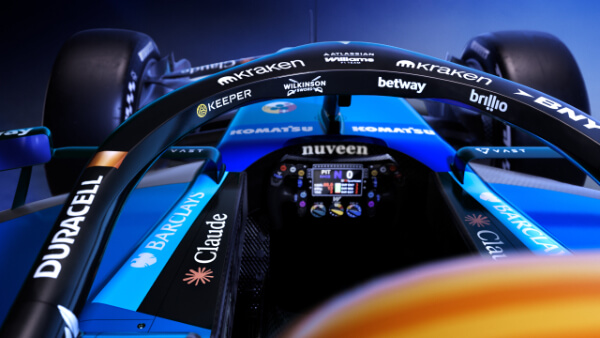
A Formula 1 race weekend is built on decisions made long before the car leaves the garage. The systems have to work and the car has to be prepared to the highest standard. At Atlassian Williams F1 Team, that preparation is part of how we create our winning formula.
From chief engineer jobs that guide car development to garage jobs that keep trackside operations moving, every role helps turn work at our Grove factory into on-track performance. Here’s a look at some of the roles that make this happen.
How do chief engineer jobs shape F1 car performance?
Chief engineer jobs in Formula 1 steer the technical direction of a car across its lifespan. The role requires a broad view of performance, development, timing and resources. Every decision has a knock-on effect, so the job is about balancing ambition with what can realistically be delivered.
For Angelos Tsiaparas, Chief Engineer, that responsibility covers the full life of a car programme.
“As a chief engineer, I’m ultimately responsible for the high-level specification of a car programme, and all the technical and developmental decisions throughout its lifecycle, from its initial concept to its last race. The ultimate target is to find the optimal trade-offs between all the ideas we have and what we can afford to do, in terms of time, effort, money and resources.”
That balance is at the heart of technical leadership in F1. The team needs people who can generate ideas and make decisions with the bigger picture in mind. It’s not only about the next upgrade or the next race. It’s also about shaping the future of the team, as Angelos shares:
“The biggest challenge we’re facing is balancing the transformation of the company and its culture with the decisions that will give us the most performance possible on the car, both for the next race and for the future.”
What does a garage electrician technician do in F1?
Garage electrician technicians help prepare, build and maintain the event garage and its associated systems. The role can include loading and unloading equipment, building and disassembling garage setups, installing and testing electrical systems, and supporting operational tasks at race and test events.
It’s a role where standards are key. Wiring, systems, safety checks and repairs all need to be completed carefully, often against tight deadlines. The garage has to function properly before the team can focus fully on performance.
These roles also support pit stop training and race weekend operations. That means working closely with garage and race teams to help deliver the standards needed at the track. It’s a good example of accountability in action: owning the task, reporting problems clearly and helping solutions land quickly.
How F1 mechanic jobs keep the car ready for the track
Formula 1 mechanic roles are right at the sharp end of race weekend delivery. A No 2 Mechanic, for example, helps assemble and disassemble race cars and components, making sure work is completed to the required specification, deadline and build procedure.
The role means spotting issues early. If a fault or discrepancy appears, it needs to be raised with the right people and followed up properly. This attention to detail protects quality and keeps the wider team informed.
The job also carries the responsibility of representing Williams on and off track. Presentation, professionalism and teamwork all matter because the race garage is a high-performance workplace.
What skills do you need for F1 engineer jobs and garage roles?
Formula 1 engineer jobs and garage roles each need specific technical skills, but many of the behaviours are shared. The team needs people who are precise, practical, curious and comfortable working with others.
Depending on the role, that could mean motorsport experience, electrical qualifications, mechanical assembly skills, hydraulic knowledge, composite laminating experience, confidence with engineering drawings or the ability to work with CAD, PLM and manufacturing systems.
Just as important is the way people work. Strong communication, attention to detail and ownership are essential. So is the willingness to develop yourself and others, because F1 moves quickly and nobody improves by standing still.
Angelos describes high performance as getting the fundamentals right first:
“High performance, at its best, means having solved the fundamentals, from the basic DNA of a car to how you deliver it at the right time and to the right quality, so you have the brain space for innovation at the next stage.”
Why build your F1 technical career at Atlassian Williams F1 Team?
Williams has a proud place in Formula 1 history, but the focus now is firmly on what comes next. The team is working through a period of transformation, bringing people together to improve and build long-term performance.
For Angelos, that sense of progress is one of the reasons the role feels exciting.
“My time at Williams has been very exciting. It was a challenge to adapt at the start, but very quickly the potential of this team was evident. I immediately wanted to understand how I could contribute to improving the fortunes of the team as much as possible from an engineering point of view. Overall, it’s been an exciting journey that we are all on to get back to the front of the grid.”
Williams is an exciting place for people who want their work to matter. In F1 technical roles, impact can mean solving an engineering problem, improving a process, preparing a component correctly or helping the team understand how to optimise car build.
As Angelos puts it:
“Because of the nature of my role, solving engineering challenges is my big motivation to come to work each day. The fulfilment of contributing towards making a step forward or improving our understanding of car behaviour and how to make a quicker and better F1 car is what makes me jump out of bed every morning.”
The importance of teamwork in an F1 garage
At Williams, teamwork is a big part of the culture. People are encouraged to share ideas and stay open to different approaches. This matters in a sport where progress often comes from small improvements made repeatedly by people pulling in the same direction.
Since joining the team, Angelos has seen that culture in action.
“Williams is a great place to work because of the potential you see around you every day. How many things you can improve relatively easily, although they take time, is motivating. On top of that, the culture and the people are different from other places I’ve worked. It’s very open, and it’s refreshing that people are happy to consider different ideas and approaches.”
Find your place in F1 technical roles
Ready to bring your skills to one of the most exciting technical environments in sport? Explore our engineering jobs, technical jobs and wider vacancies today, or join our talent community to stay connected with future opportunities.